Egg White Lysozyme for Food Preservation
Process guide for food and beverage plants using egg white lysozyme: where it fits, addition point, QC, pilot validation, troubleshooting weak results and supplier qualification.
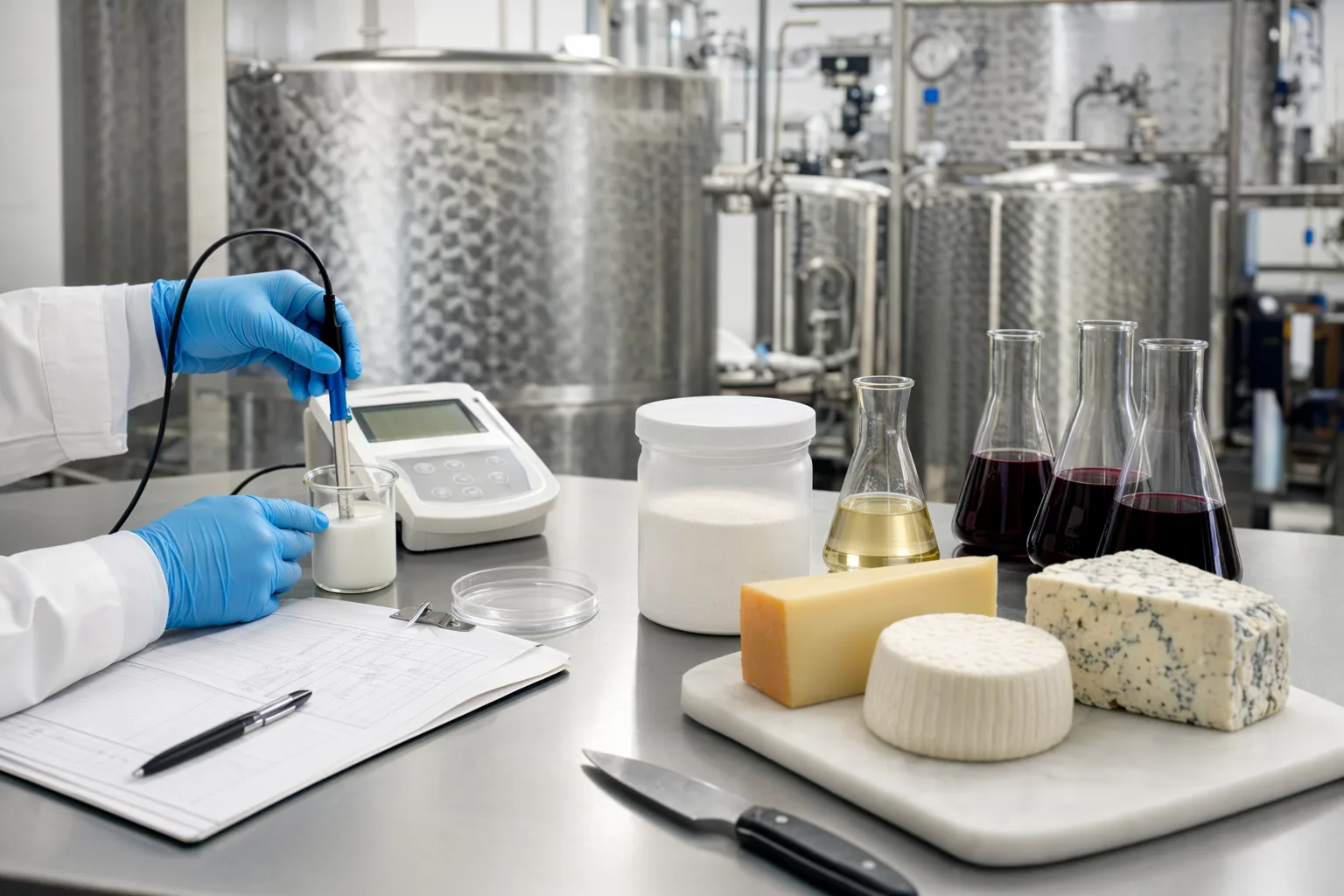
Spoiled cheese wheels, wine that turns in tank and brined products that fail early all cost more than the enzyme. This guide is for food and beverage plants, formulators and resellers who want egg white lysozyme to work in production, not only in the lab: where it fits, where to add it, how to validate it, and what to check when results are weak.
What Is Lysozyme in Industrial Food Preservation?
What is lysozyme in a food plant context? It is an antimicrobial enzyme, commonly sourced from egg white, that hydrolyzes beta-1,4 linkages in peptidoglycan within bacterial cell walls. The main lysozyme function is therefore strongest against many Gram-positive bacteria, while Gram-negative organisms may require additional hurdles because their outer membrane limits access. For B2B buyers, egg white lysozyme is not positioned as a supplement or medical ingredient; it is a processing aid or food preservative ingredient subject to local regulatory and labeling requirements. Commercial forms may be described as lysozyme, lysozyme enzyme, lysozyme protein, protein lysozyme, or lysozyme chloride depending on supplier terminology and salt form. In preservation systems, it is typically evaluated alongside pH control, salt, temperature, hygiene, starter cultures, filtration, and packaging. The practical question is not whether lysozyme works in theory, but whether it delivers measurable microbial control in the target matrix.
Primary target: Gram-positive spoilage and process-risk organisms. • Common source: egg white, requiring allergen review. • Best used as part of a validated hurdle system.
Where Egg White Lysozyme Fits: Cheese, Wine, and Brines
Egg white lysozyme is most established in cheese and wine applications, with additional use cases in brines, sauces, seafood systems, and refrigerated prepared foods where formulation and regulation allow. In hard and semi-hard cheese, it is evaluated for control of gas-forming bacteria that can contribute to late blowing and texture defects. In wine, lysozyme can help manage lactic acid bacteria, often as part of a program involving sulfur dioxide, filtration, pH, and cellar hygiene. In aqueous food systems, it may be dosed into brines, coatings, or marinades where uniform distribution is achievable. Performance depends heavily on matrix composition: proteins, polyphenols, fat, ionic strength, and suspended solids can bind or reduce apparent activity. A supplier should help translate laboratory activity into process dosage, but the processor must confirm performance at plant scale using its own raw materials, sanitation status, packaging, and shelf-life targets.
Cheese: validate against gas defects and spoilage indicators. • Wine: confirm compatibility with style, turbidity, and filtration. • Brines and coatings: verify mixing, contact time, and residue expectations.
Process Conditions and Addition Point
Treat pH, temperature, salt and contact time as one package. A stated optimum, such as the pH 6.0–9.0 and 37°C–50°C working range we give for our powder, does not apply unchanged to every matrix; wine behaves differently from milk or brine. Temperature management is one of the most common lysozyme troubleshooting points. Like other proteins, lysozyme can lose activity when exposed to excessive heat, long hot holds, or aggressive processing conditions, so do not assume it survives pasteurization, cooking, spray drying or hot filling without supplier data and plant validation. In many preservation workflows the best addition point is after the main heat step, during a controlled cooling or blending stage where mixing is adequate. Hold time should be long enough for enzyme contact before downstream separation, filtration, or packaging. Set the dose by a dose-response trial in your own product and align it with local food regulations and allergen labeling obligations.
Screen pH, temperature, contact time, and salt level together. • Avoid dosing immediately before a step that removes or denatures the enzyme. • Map actual tank temperature and residence time. • Use microbial challenge data rather than label activity alone.
QC Checks for Incoming Lots and Finished Product
A robust QC plan begins before the lysozyme reaches the plant. Each lot should arrive with a COA confirming activity, appearance, moisture or loss on drying if specified, microbiological limits, heavy metal limits where relevant, and identity. The TDS should define enzyme activity units and assay method, because activity numbers are not interchangeable across methods. The SDS should cover handling controls for powdered enzyme dust, respiratory sensitization risk, PPE, and spill cleanup. In-process checks should include dissolution quality, dose verification, pH, temperature at addition, mixing time, and lot traceability. Finished product validation should measure target organisms or approved indicator organisms, total plate count where relevant, sensory impact, shelf-life performance, and any interaction with starter cultures. For allergen control, confirm egg-derived status, segregation, cleaning, and label review with the processor’s regulatory team.
Verify activity method, not just activity value. • Track enzyme lot to production lot. • Include sensory and starter-culture checks in validation.
Pilot Validation and Scale-Up Method
Pilot validation should be designed as a dose-response study rather than a single confirmation batch. Run an untreated control, a low dose, a target dose, and a high dose under the same raw material and process conditions. For food preservation, define success in advance: reduced spoilage organisms, delayed gas formation, stable acidity, reduced defect rate, or extended shelf life without unacceptable sensory change. Sampling should cover post-addition, post-processing, early storage, mid-shelf-life, and end-of-shelf-life points. In cheese, monitor curd behavior, moisture, salt, pH, starter performance, eye formation, and defect incidence. In wine, monitor lactic acid bacteria, malolactic status, haze risk, filtration behavior, color, aroma, and mouthfeel. Scale-up should confirm mixing energy, addition point, powder hydration or solution preparation, and residence time. A successful benchtop result is only purchasing evidence after pilot and plant data confirm repeatability.
Use controls and multiple dosage levels. • Define pass/fail criteria before the trial. • Repeat with normal raw material variation.
Supplier Qualification and Cost-in-Use
Industrial procurement should evaluate egg white lysozyme on delivered performance, not only price per kilogram. Compare suppliers by activity basis, assay method, usable solids, solubility, microbiological specification, allergen documentation, packaging size, shelf life, storage conditions, and technical support. Cost-in-use equals the cost required to achieve the validated preservation outcome at the plant’s real dose, including yield protection, reduced defects, rework avoidance, waste reduction, cleaning impact, and any labeling or regulatory burden. Ask for current COA examples, TDS, SDS, allergen statement, country of origin, GMO position if needed, kosher or halal documentation only if actually required, and change-control notification practices. For supply continuity, qualify at least one technically equivalent backup source after side-by-side trials. Terms such as lysozyme 90mg or lysozyme mouthwash UK are consumer or healthcare search contexts; they should not guide industrial food enzyme purchasing decisions.
Compare activity delivered per process dose. • Require change-control and traceability commitments. • Qualify backup supply with pilot data, not paperwork alone.
Troubleshooting Checklist for Weak Lysozyme Results
If lysozyme protein is not delivering the expected preservation effect, investigate the full process before changing supplier or increasing dosage. First, confirm that the target organism is lysozyme-susceptible and that initial contamination is within the intended control range. Next, check whether the enzyme was stored correctly, dispersed fully, and added at the validated process step. Review pH, temperature exposure, salt level, and competing matrix components. Compare the actual lot COA activity with the trial lot used during development. Revisit sampling points: a poor mixing pattern can make one sample look compliant and another fail. For beverages such as wine or for cheese applications, confirm that the target microorganisms and sensory constraints match the original validation. Escalate only after documenting deviations, running a controlled repeat, and calculating whether a revised dose is commercially justified.
Verify organism susceptibility and baseline microbial load • Check storage, hydration, dispersion, and addition sequence • Compare plant conditions with pilot validation records • Review COA activity and lot-to-lot variation • Use controlled repeat trials before changing specification
Technical Buying Checklist
1. Define the defect and the target organism before the trial (gas defects in cheese, lactic acid bacteria in wine, surface spoilage in brined or coated products).
2. Fix the addition point: after the main heat step, with measured tank temperature and hold time.
3. Record how the powder is dissolved or dispersed, and the mixing time.
4. Run an untreated control and at least three dose levels under normal raw-material variation.
5. Sample after addition, after processing, and at early, mid and end of shelf life.
6. Keep retained samples of the trial lot and compare every production lot's COA activity with it.
7. Write pass/fail criteria and the cost-in-use per batch before you scale up.
Request Trial Material and a Quote
Tell us the product you make, the process step where lysozyme will go in, the batch size, the quantity you expect per order or per year, and the destination country. Distributors and resellers can request the same way for their customers' applications. We reply within 24 hours with sample availability, COA and a quote; packs are 1 kg, 5 kg and 25 kg.
Lysozyme for Research & Industry
Need Lysozyme for your lab or production process?
ISO 9001 certified · Food-grade & research-grade · Ships to 80+ countries
Frequently Asked Questions
Is egg white lysozyme the same as lysozyme enzyme used in food?
Egg white lysozyme is one of the most common commercial sources of lysozyme enzyme for food applications. It is a lysozyme protein with antimicrobial activity, mainly against Gram-positive bacteria. Buyers should confirm the declared source, activity method, purity profile, allergen status, and regulatory suitability. Do not assume two lysozyme products are equivalent unless their specifications and pilot performance match.
What dose of egg white lysozyme should a food plant start with?
Starting dose depends on the food matrix and target organism, and on the use level your market permits. Begin from the supplier's recommendation for your application, then test an untreated control and several dose levels. Final dosage should be based on microbial challenge data, sensory checks, regulations, and cost-in-use.
Does lysozyme replace pasteurization or sanitation?
No. Lysozyme is best treated as one hurdle within a validated preservation system. It does not replace hygienic design, sanitation, thermal processing, filtration, pH control, salt, cold chain, or packaging controls. Its strongest value is targeted reduction or inhibition of susceptible bacteria in suitable matrices. Processors should validate performance under normal and worst-case conditions before relying on it commercially.
What documents should be requested from a lysozyme supplier?
Request a current COA for each lot, a TDS with activity method and application guidance, an SDS for safe handling, an allergen statement, origin information, shelf-life and storage data, and relevant regulatory statements for the target market. For supplier qualification, also ask about change-control notifications, traceability, packaging options, lead time, and technical support for pilot trials.
Are consumer terms like lysozyme 90mg relevant to B2B food preservation?
Usually not. Terms such as lysozyme 90mg or lysozyme mouthwash UK relate to consumer, oral-care, or healthcare contexts and should not be used to specify an industrial food preservative. Food manufacturers should specify lysozyme by source, activity units, assay method, food-grade suitability, allergen documentation, microbiological specification, application data, and validated process dose.
Why did lysozyme work in the lab but fail in production?
Common causes include different pH, higher bioburden, incomplete mixing, heat exposure, salt or protein interference, different addition point, or a lot with different activity. Lab buffer tests can overstate performance compared with real foods. Compare plant records with pilot conditions, verify COA activity, repeat the test under controlled conditions, and confirm target-organism susceptibility.
Can lysozyme survive heat processing?
Lysozyme is a protein enzyme, so heat exposure can reduce activity depending on temperature, time, pH, moisture, and formulation. Do not assume it will survive pasteurization, cooking, hot filling, or drying without data. If the process includes heat, evaluate post-heat addition where possible or validate residual performance through microbiological testing under production-like conditions.
Related: Lysozyme for antimicrobial control in food systems
Request lysozyme specifications, samples, and pilot-support guidance for your food preservation process. See our application page for Lysozyme for antimicrobial control in food systems for specs, MOQ, and a free 50 g sample.
Contact Us to Contributehello@mail.enzymedesk.com